Mallorca's public transport is a good option for visitors: it covers the airport, Palma's beaches, the coastal resorts and the main towns, and with a contactless card it is cheap. But there are three different bodies with three different logics, and nobody explains it all in one place.
Score
- Price
- 4.5/5By card, discounts from 40 % and a group fare for up to 5 people
- Coverage for visitors
- 4/5Airport, beaches, Calvià and towns; no bus to Sa Calobra
- Frequency
- 4/5A1 every 12–15 min, beaches every ~10 min; coastal TIB less frequent
- Simplicity
- 3/5Two fare systems, tap out on TIB, summer-only lines
- Summer capacity
- 3/5TIB buses full from the first stop on some lines
Pros
- A contactless bank card works on EMT and TIB, no need to buy anything
- One card pays for up to five travellers with a group discount
- Night bus to the airport and the A1 every 12–15 minutes
- EMT beach lines every ~10 minutes from the cathedral
Cons
- EMT and TIB have different prices, rules and websites
- Forget to tap out of a TIB bus and you pay a €0.30 penalty per person
- The airport lines to Alcúdia and Cala Millor change in winter
- Some coastal TIB buses are full in summer
What it offers: three operators, one traveller
EMT Palma (Empresa Municipal de Transports Urbans de Palma) belongs to the City Council and runs the city buses, including the A1 and A2 airport lines and the night buses. For visitors, the key lines are:
- A1: airport → Plaça d'Espanya → Passeig Mallorca (we explain it in airport and transfers).
- A2: airport → Can Pastilla → Playa de Palma → S'Arenal.
- 1: centre → Passeig Marítim → cruise terminals (cruise port).
- 25: cathedral → the whole of Playa de Palma, every ~10 minutes.
- 35: cathedral → Portixol → Ciutat Jardí → Cala Estància → aquarium.
- 4: centre → Cala Major → Cala Nova → Illetes.
The last three are, in practice, the city's beach lines (Palma beaches). The old line 15 to Playa de Palma no longer exists, although it still appears in old guides.
TIB is the Balearic Government's island-wide network: intercity buses, run by contracted companies, plus the trains and metro of SFM (Serveis Ferroviaris de Mallorca). Almost everything leaves from the Estació Intermodal, beneath Plaça d'Espanya: buses to Calvià (104 to Palmanova and Magaluf, 103 to Santa Ponça), the 203 to Valldemossa, Deià and Sóller, the 301 to Port de Pollença, and the T1 train to Inca, T2 to Sa Pobla and T3 to Manacor, which drops you at Sineu market on Wednesdays.
The Sóller train is something else: a private heritage train, with its own station next to Plaça d'Espanya and its own prices. It is not part of the TIB system (Sóller train).
Prices: official versus platforms
For buses and trains you do not need a middleman: you pay on board or at the station machine, and there is no tourist pass that would save you money.
- EMT: €2 in cash within Palma and €5 on the A1 and A2. With a contactless card, the discount starts at 40 % for the first person. Paying cash there are no transfers and the maximum change given is €10. Under-5s travel free with an adult. A rise to €3 has been initially approved (and a cut to €4.50 for the airport) but is not yet in force: check EMT fares.
- TIB by card: you pay by zone "jumps". First person: €1.80 (0 jumps), €2.70 (1), €3.60 (2), €4.50 (3) and €5.40 (4, the maximum). The second to fifth people on the same card pay less. In cash, €3 to €13.50 depending on the journey, notes of up to €20 only and no transfers.
- Train and metro: single tickets from the machines at each station (cash or card) and ticket offices in Palma, Inca and Manacor. A train ticket is not valid for transferring to the bus.
The Tarjeta Única (TIB) and Tarjeta Ciudadana (Palma) cards are for Balearic residents only, who travel free.
Where the platforms do come in is airport transfers. A shared transfer costs from €13 per person, against €5 on the A1: worth it if you are going far from Palma or have lots of luggage.
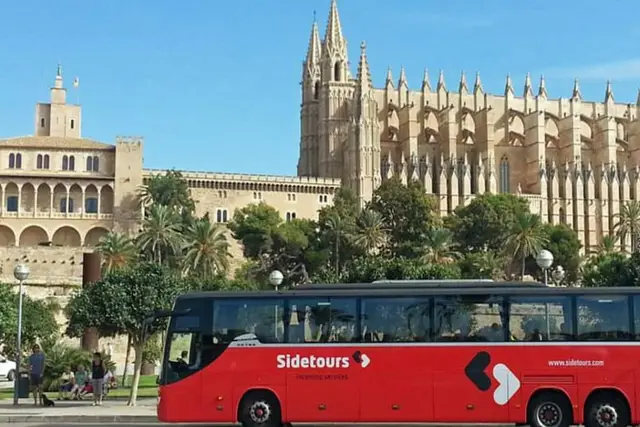
GetYourGuide3 hours
Sights· Rest of the island
Mallorca: Shared 1-way transfer from airport to hotel
4.4 (565)
from €13Check availability
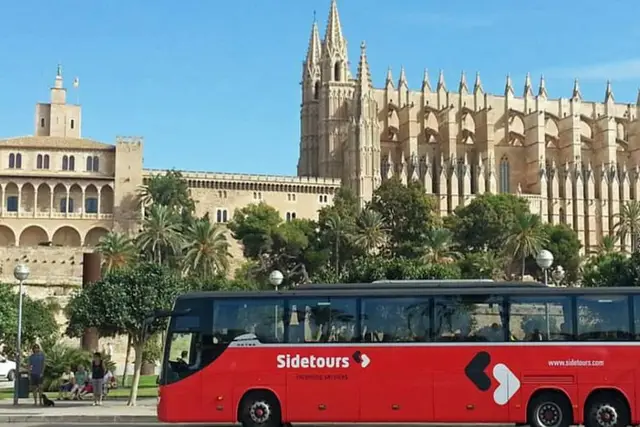
GetYourGuide3 hours
Sights· Palma city
Mallorca: Shared One-Way Transfer to Palma Airport
4.5 (220)
from €13Check availability

GetYourGuide4 hours
Sights· Rest of the island
Mallorca: Cova des Coloms Caving Trip with Hotel Transfer
4.9 (1,984)
from €75Check availability
See everything on GetYourGuide →Prices checked on 6 October 2026
How to pay and validate: the rules that matter
How to use your card on TIB (bus, train and metro)
- Tap your contactless card on the reader when you board. If several of you are travelling on the same card, tap once per person.
- Tap again when you get off. If you do not, you are charged a €0.30 penalty per person.
- You can make up to two transfers (three lines) within 60 minutes, and you never pay more than the 4-jump fare.
- Your bank groups the journeys and charges you the next day; it may hold up to €20 as a pre-authorisation.
TIB's terms are on tib.org and SFM's trains and engineering works on trensfm.com.
What travellers and the local press say
Rather than reviews, this is what keeps coming up in the local press:
- Full TIB buses in summer: last August there were reports of buses full from the first stop on lines 101, 204, 501, 504 and 515. If you are travelling in July or August, board at the first stop or set off early.
- Taxis versus ride-hailing: the Balearic Government and the taxi trade are at odds over licences for private-hire cars with drivers. Uber operates in Mallorca; Bolt and Cabify do not.
- Line changes: the A1 no longer goes via the port, line 15 has gone, and the A32 and A42 airport lines are replaced by the A33 and A43 from 1 November to the end of March.
Alternatives
If the bus does not suit you, the alternatives are a taxi (metered, minimum €16.95 from the airport), pre-booked transfers and, for touring the city with commentary, the hop-on hop-off bus; if you only need transport, the EMT 1 covers its stretch of the Passeig Marítim and the port for €2. To reach places without a bus, such as Sa Calobra or Es Trenc, see day trips. And if you are hiring a car, check the camera-controlled zones in the centre first in airport and transfers.
Frequently asked questions
Can I pay by card on the EMT bus in Palma?
Yes. A contactless bank card is the cheapest ticket: a discount from 40 % for the first person and a group fare for up to five travellers on the same card.
How much is the bus in Palma?
€2 in cash within the city and €5 on the A1 and A2 airport lines. With a contactless card you pay less.
Is there a tourist travel card in Mallorca?
No. The TIB and EMT cards are for residents. Visitors use their own contactless bank card on EMT and TIB.
Is the Sóller train included in TIB?
No. It is a private train with its own station and prices. TIB covers the SFM trains to Inca, Sa Pobla and Manacor, and the metro.
What happens if I do not tap my card when getting off a TIB bus?
You are charged a €0.30 penalty per person on top of the fare. So it is worth tapping out even if you are in a hurry.